
Could it be ADHD?
ADHD is one of the most misunderstood neurodevelopmental conditions.
For many people, it doesn’t look like bouncing off the walls or being unable to sit still. It can look like constantly feeling overwhelmed, forgetting things despite trying your best, procrastinating until the last minute, starting dozens of projects you never finish, or feeling like everyday life takes far more effort than it seems to for everyone else.
You might have spent years believing you were lazy, disorganised, unreliable or “too much”. You might have developed elaborate systems just to keep up, without realising how much energy those systems require.
Whether you’re here because you’re wondering about yourself, your child, your partner or someone you care about, you’re in the right place.
This guide is designed to help you understand what ADHD really is, how it presents across different ages and genders, and where to go next if you’re seeking answers.
What is ADHD?
Attention Deficit Hyperactivity Disorder (ADHD) is a neurodevelopmental condition that affects the brain’s executive functioning.
Executive functions are the mental skills we rely on every day to plan, organise, prioritise, regulate emotions, manage time, switch between tasks and follow through on intentions.
For people with ADHD, these skills don’t always work consistently.
That doesn’t mean they can’t focus.
In fact, many people with ADHD can focus intensely on things that are interesting, urgent or emotionally engaging. The challenge is often regulating attention, rather than simply having too little of it.
ADHD affects people differently, which is why no two people experience it in exactly the same way.
ADHD isn't just about attention
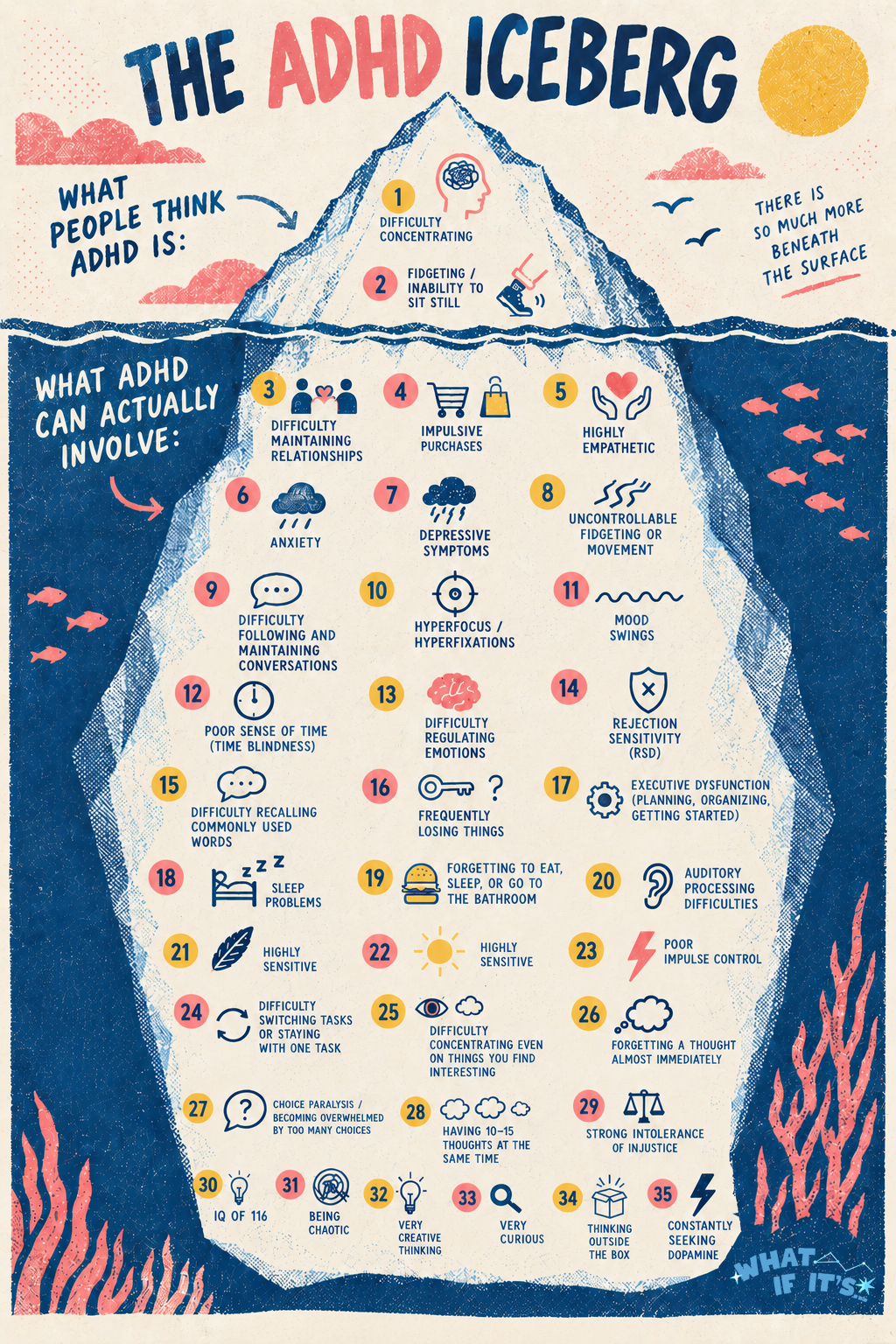
Despite the name, ADHD can affect much more than your ability to pay attention.
It can influence how you start tasks, manage time, remember things, regulate impulses, handle emotions, switch gears and organise everyday life.
And it doesn’t look the same for everyone.
ADHD is generally described as having three presentations: predominantly inattentive, predominantly hyperactive-impulsive, and combined.
It’s not always obvious
Inattentive ADHD is often the quieter presentation. Someone might seem dreamy, forgetful or disorganised, have trouble following instructions or struggle to finish things they’ve started. Because they aren’t necessarily disruptive, their ADHD can be easier to miss.
Hyperactive-impulsive ADHD tends to be more visible. It can involve restlessness, lots of movement or talking, difficulty waiting, interrupting and acting before thinking. But hyperactivity isn’t always physical. It can also feel like an internal restlessness or a brain that’s constantly “on”.
Combined ADHD includes significant traits from both. Someone might struggle with attention and organisation while also experiencing restlessness, impulsivity or a constant drive for stimulation.
These presentations aren’t different “types of people”. They’re different ways ADHD symptoms can cluster, and how they show up can change over time.
The same ADHD can look different as you grow
ADHD doesn’t necessarily look the same at 8, 18 and 38.
A child who is constantly moving, climbing and calling out in class might grow into an adult who feels restless sitting through a meeting, talks quickly or always needs to be doing something.
A child who stares out the window, forgets their school hat and needs five reminders to put their shoes on might become an adult who misses appointments, loses their phone and relies on calendars, alarms and lists to keep life running.
And sometimes ADHD becomes more noticeable in adulthood, not because it suddenly appeared, but because life became more complicated.
School timetables, parents and teachers can provide a lot of external structure. Adulthood suddenly asks you to manage work, bills, appointments, relationships, meals, housework, children and approximately 900 other things yourself.
The underlying ADHD may be the same. The demands placed on it aren’t.
It’s the pattern that matters
Almost everyone procrastinates, forgets things, gets distracted or makes impulsive decisions sometimes.
With ADHD, clinicians look at the bigger pattern: how often these difficulties occur, how long they’ve been present, whether they appear across different parts of life and how much they affect everyday functioning.
That’s also why ADHD can be difficult to recognise from a simple list of symptoms.
Sometimes it’s easier to recognise it in everyday life.
What can ADHD look like?
ADHD doesn’t look the same for everyone. And it isn’t always obvious.
Sometimes it’s losing your keys again. Sometimes it’s having 37 browser tabs open. Sometimes it’s being able to spend five hours on something fascinating but feeling completely unable to start a 10-minute admin task.
You might recognise yourself in questions like these.
You know what you need to do. You might even want to do it.
But instead of starting, you sit there thinking about the task. You make a coffee. Check your phone. Do something completely unrelated. Tell yourself you'll start in five minutes.
Then the deadline gets dangerously close and suddenly you can do three hours of work in 45 minutes.
How this can connect to ADHD: Starting a task relies on executive functions, the mental processes that help us direct our attention and behaviour towards a goal. ADHD is associated with differences in executive functioning and motivation, which can make initiating low-interest or delayed-reward tasks particularly difficult. Urgency can change the motivational equation, which may help explain why some people with ADHD find it much easier to act when a deadline becomes immediate.
Every time, you promise yourself you'll start earlier.
And you genuinely mean it.
But tomorrow becomes next week, next week becomes tomorrow, and somehow you're doing the thing at 11.47 pm the night before it's due.
How this can connect to ADHD: Research suggests ADHD can involve altered reward processing and a stronger preference for immediate over delayed rewards. A task whose payoff is somewhere in the future may therefore struggle to compete with something rewarding right now. As the deadline approaches, the consequences become immediate too, which can make the task much more motivating.
Keys. Phone. Wallet. Glasses. Water bottle.
The thing you were literally holding 30 seconds ago.
You may even have a designated place for everything, yet regularly find yourself wandering around the house asking, "Where did I put my phone?"
How this can connect to ADHD: Working memory is the temporary mental workspace that helps you hold information in mind while you're doing something. Research has found significant working-memory difficulties in adults with ADHD. If your attention shifts while you're putting something down, the information about where you put it may not be encoded or held strongly enough for you to retrieve it later.
ou're listening. You're interested. You aren't trying to be rude.
But a thought arrives and suddenly it's coming out of your mouth before the other person has finished.
Or you're concentrating so hard on not forgetting what you wanted to say that you stop properly listening to what they're saying.
How this can connect to ADHD: Impulsivity and difficulty inhibiting responses are established features of ADHD. Working-memory difficulties can add another layer: holding onto your thought while continuing to listen may require more mental effort, creating an urge to say it before it disappears.
Reply to the email. Book the appointment. Put the washing away. Pay the bill. Decide what's for dinner. Fill in the form.
None of those things seems particularly difficult.
But when they're all competing for your attention at once, figuring out what to do first can feel harder than actually doing any of them.
So you do... nothing.
How this can connect to ADHD: Executive functions help us prioritise, sequence actions, ignore competing information and move from intention to action. When these processes are under strain, several small demands can become one enormous cognitive traffic jam. ADHD-related working-memory difficulties can make keeping track of multiple priorities harder too.
Some days you answer 17 emails, reorganise the pantry, clean the bathroom and finally fix the thing that's been broken for six months.
The next day, sending one email feels enormous.
It can leave you wondering, "If I could do all of that yesterday, why can't I just do this today?"
How this can connect to ADHD: ADHD isn't simply an inability to pay attention or get things done. Research points to difficulties regulating attention, motivation and effort according to the demands of a situation. Performance can therefore change considerably depending on factors such as interest, stimulation, reward and task demands.
You need to leave at 8.30 am.
At 8.00 am, you think, plenty of time.
Then you answer an email, remember you need your water bottle, can't find your shoes, decide you have time to empty the dishwasher and somehow it's 8.37 am.
Again.
How this can connect to ADHD: Research has found measurable differences in time perception in ADHD, alongside difficulties with executive functions such as planning and working memory. This can contribute to consistently underestimating how long something will take or struggling to translate "I need to leave at 8.30" into all the smaller steps required to actually leave at 8.30.
ou discover pottery.
Within 48 hours you've watched 19 tutorials, researched kilns, joined three Facebook groups and bought enough equipment to suggest you're opening a ceramics studio.
Three weeks later?
Nothing.
The clay joins the guitar, sourdough starter, crochet hooks and half-finished online course.
How this can connect to ADHD: ADHD is associated with differences in motivation and reward processing. Novel, interesting and immediately rewarding activities can be particularly engaging, while maintaining effort once something becomes familiar or repetitive can be much harder. That doesn't mean every intense hobby is ADHD, but a repeated pattern of novelty-driven engagement followed by rapid loss of interest can fit with how motivation operates in ADHD.
You can't make yourself complete a simple form.
But apparently you can spend an entire afternoon researching the best neighbourhood to stay in Tokyo for a holiday you haven't booked.
You look up and realise it's dark outside and you haven't eaten lunch.
How this can connect to ADHD: The "attention deficit" part of ADHD can be misleading. The difficulty is often regulating and directing attention rather than simply having too little of it. Research shows that performance in ADHD can vary depending on stimulation, reinforcement and reward, helping explain why engaging activities can hold attention much more effectively than repetitive ones.
This planner will change everything.
Or maybe the problem was the planner and what you really need is an app.
Actually, perhaps you need a colour-coded wall calendar.
For two weeks, the new system is incredible.
Then you forget it exists.
How this can connect to ADHD: New systems provide novelty, immediate feedback and the rewarding feeling of making progress. Maintaining the system once it becomes repetitive is a very different executive-function task. ADHD-related differences in reward processing may help explain why creating a new system can feel far more engaging than consistently using it.
Make the list.
Rewrite the list.
Colour-code the list.
Research the best app for managing the list.
Add something you've already completed so you can tick it off.
Still haven't made the phone call that's been sitting at number one since Tuesday.
How this can connect to ADHD: Planning something and initiating it rely on overlapping but different processes. Making a list provides structure and an immediate sense of progress, while completing a boring or uncomfortable task may offer little immediate reward. ADHD is associated with both executive-function difficulties and differences in how immediate versus delayed rewards influence behaviour.
Podcast while cleaning.
Music while working.
Phone while watching TV.
Doodling during a meeting.
Coffee before starting anything.
Sometimes one activity simply doesn't feel like enough.
How this can connect to ADHD: Research suggests that stimulation and reward can affect cognitive performance differently in people with ADHD. Some theories propose that increasing stimulation can help regulate arousal and attention, which may help explain why adding movement, sound or another source of stimulation can sometimes make a low-stimulation activity easier to sustain.
You went online to buy toothpaste.
Forty minutes later you've found an incredible bargain on shoes, ordered equipment for your newest hobby and somehow you're researching espresso machines.
It felt extremely important at the time.
How this can connect to ADHD: Impulsivity is one of ADHD's core symptom domains. Research also finds differences in reward-based decision-making and a tendency, on average, to place greater value on smaller or more immediate rewards compared with delayed ones. That combination can make the immediate excitement of buying the thing harder to interrupt with consideration of the longer-term consequences.
Coffee. Something sweet. A bargain. A new hobby. Another project. A spontaneous plan. A harder workout. Another episode. Another level. Another scroll.
Sometimes everyday life just feels painfully boring unless there's something happening.
How this can connect to ADHD: You'll often hear this described online as "dopamine seeking". The science is more nuanced. Dopamine is involved in ADHD, but researchers also find broader differences in reward anticipation, reinforcement, motivation and preference for immediate rewards. Novel, stimulating or immediately rewarding experiences may therefore be particularly compelling for some people with ADHD.
Buy it.
Say it.
Send the message.
Have another drink.
Stay up for another episode.
Drive faster than you should.
Agree to something without thinking about whether you actually have time for it.
The thought and the action can sometimes feel almost simultaneous.
How this can connect to ADHD: Impulsivity involves difficulty pausing or inhibiting a response long enough to consider what happens next. Research also shows altered reward-based decision-making in adults with ADHD, including greater weighting of immediate rewards in some situations. This can affect far more than interrupting or fidgeting. It can influence spending, eating, driving, substance use, gambling, sex and everyday decision-making.
Someone's tone changes and you think about it for the rest of the day.
A small criticism feels enormous.
A frustrating inconvenience makes you disproportionately angry.
An exciting idea makes you feel unstoppable.
Then sometimes the emotion disappears almost as quickly as it arrived.
How this can connect to ADHD: Emotional dysregulation isn't currently one of the core diagnostic criteria for ADHD, but research consistently finds it is more common in adults with ADHD. A meta-analysis found substantially greater emotional dysregulation in adults with ADHD than controls, particularly emotional lability and strong negative emotional responses.
Put the return parcel in a cupboard?
That parcel no longer exists.
Put the vegetables in the crisper drawer?
Congratulations. You've created compost.
You might deliberately leave things in visible places because if they're out of sight, you're much less likely to remember them.
How this can connect to ADHD: This isn't literally "object permanence", despite the term often being used online. A better explanation is working memory and prospective memory. ADHD is associated with working-memory difficulties, which can make it harder to keep information mentally active when there is no external reminder prompting you.
You pick up your phone to pay a bill.
There's a message.
You reply.
Then you see Instagram.
Seven minutes later you put the phone down.
The bill remains unpaid.
How this can connect to ADHD: Working memory allows you to temporarily hold your original goal in mind while other information competes for your attention. Meta-analytic research has found working-memory difficulties in adults with ADHD, which can make the original intention easier to lose when something else captures your attention.
You can solve a complicated problem at work.
You can organise an overseas holiday.
You can teach yourself an entirely new skill because you became interested in it on Tuesday.
But you've been meaning to book that appointment for six months.
How this can connect to ADHD: Difficulty in ADHD doesn't necessarily correspond neatly with how objectively difficult a task is. Long, repetitive and mundane tasks can exacerbate ADHD symptoms, while reward and stimulation can improve performance. That's why something challenging but fascinating may sometimes feel easier than something simple but boring.
Almost everyone gets obsessed with something new occasionally.
Almost everyone procrastinates.
Almost everyone scrolls longer than they intended or buys something they didn't really need.
The question isn't:
"Do I do this?"
It's more useful to ask:
"How often does this happen, how long has it been happening, and how much does it affect my life?"
Maybe you've always described yourself as someone who gets bored easily.
Someone who has "no self-control" around shopping.
Someone who works best under pressure.
Someone who constantly starts things and never finishes them.
Someone who needs three things happening at once.
Someone who has always been impulsive.
Someone who can achieve incredible things when interested but struggles inexplicably with ordinary everyday tasks.
Individually, those experiences can have many explanations.
But when they sit alongside persistent difficulties with attention, organisation, working memory, time management, task initiation or impulsivity, the bigger picture may be worth exploring.
Sometimes the ADHD lightbulb moment isn't recognising one enormous symptom.
It's realising that dozens of seemingly unrelated things you've been doing your entire life might actually be connected.
ADHD can overlap with other conditions
ADHD doesn’t always come neatly packaged on its own.
In fact, having another condition alongside ADHD is common. According to the Australian Evidence-Based Clinical Practice Guideline for ADHD, around two-thirds of children and adolescents with ADHD have a co-occurring mental health condition, while up to 80% of adults with ADHD have at least one additional mental health disorder.
When two or more conditions occur together, they’re often described as co-occurring conditions or comorbidities.
These can include:
- Autism
- Anxiety disorders
- Depressive disorders
- Dyslexia, dyscalculia and other specific learning disorders
- Oppositional defiant disorder (ODD)
- Obsessive-compulsive disorder (OCD)
- Sleep disorders and difficulties
- Eating disorders
- Substance use disorders
- Developmental coordination disorder
- Tic disorders
The conditions most commonly seen alongside ADHD can also change with age.
According to the Australian ADHD Clinical Practice Guideline, common co-occurring conditions in childhood include specific learning disorders, ODD, language disorders, autism and anxiety disorders. Depressive disorders and substance use disorders become more prominent through adolescence and adulthood.
A 2025 systematic review and meta-analysis of almost 40,000 children and adolescents with ADHD found that 34.7% also had ODD, 30.7% had behavioural disorders and 18.4% had an anxiety disorder. Every psychiatric disorder examined in the review was more common among children and adolescents with ADHD than in the general population.
The overlap doesn’t always work equally both ways
This is an interesting, and sometimes confusing, part of understanding co-occurring conditions.
Take ADHD and autism.
They’re strongly associated, but the percentage depends on which group you start with.
A large population-based study of almost 1.9 million people found that around 48% of autistic people also had ADHD, while around 17% of people with ADHD also had autism.
Another meta-analysis specifically looking at children and adolescents with ADHD estimated that around 21% also met criteria for autism.
So while you’ll see different percentages depending on the population and study design, the important point is:
ADHD is particularly common among autistic people.
Autism also occurs more often among people with ADHD than in the general population, but having ADHD doesn’t mean you’re likely to also be autistic.
This difference partly reflects the fact that ADHD is more common in the population overall. It’s also why statistics about “overlap” can be misleading without knowing which population researchers started with.
Sometimes the symptoms themselves overlap
There’s another layer to all of this: different conditions can produce experiences that look remarkably similar from the outside.
Difficulty concentrating might be related to ADHD, anxiety, depression or poor sleep.
Avoiding a task might involve ADHD-related executive dysfunction, anxiety about getting it wrong, or both.
Sensory overwhelm and difficulty switching between activities can occur with ADHD and autism.
Difficulty at school might involve ADHD, dyslexia, dyscalculia or a combination of them.
This is known as differential diagnosis, which essentially means working out which condition, or combination of conditions, best explains what someone is experiencing.
The Australian ADHD Clinical Practice Guideline specifically recommends considering both co-occurring conditions and alternative explanations during an ADHD assessment, because one condition can sometimes mask another.
And not everything associated with ADHD is a comorbidity
You may also come across terms such as emotional dysregulation, hyperfocus, time blindness and rejection sensitive dysphoria (RSD) when reading about ADHD.
These aren’t separate ADHD comorbidities in the same way that autism, an anxiety disorder or dyslexia can be.
For example, RSD isn’t currently a formal clinical diagnosis. It’s a term commonly used to describe particularly intense emotional responses to perceived rejection, criticism or failure.
It’s useful to distinguish between:
Co-occurring conditions, such as ADHD and autism.
Overlapping symptoms, where different conditions can produce similar experiences.
Associated experiences, such as time blindness or emotional dysregulation, which may be discussed in relation to ADHD without being separate diagnoses.
Looking at the whole picture
This is one reason a comprehensive ADHD assessment goes beyond a checklist of symptoms.
It’s not only asking:
“Is this ADHD?”
It’s also asking:
“Could something else explain this?”
“Is there more than one thing happening?”
“And how do all of these pieces fit together?”
Sometimes the answer isn’t ADHD or something else.
It’s ADHD and something else.
Understanding the bigger picture can provide a much clearer explanation of why someone’s brain works the way it does.
Wondering if you might have ADHD?
If you’ve been reading this page and thinking, “This sounds a little too familiar,” you’re not alone.
For many people, wondering about ADHD doesn’t start with a dramatic realisation. It’s often a series of small moments of recognition.
“Wait, that’s an ADHD thing?”
“Other people find this hard too?”
“Could this explain why I’ve always struggled with that?”
You don’t need to know the answer yet.
If ADHD feels like it could be part of your story, the next step isn’t to diagnose yourself. It’s to stay curious and keep exploring.
You might:
- Complete the Adult ADHD Self-Report Scale (ASRS). The Adult ADHD Self-Report Scale was developed in conjunction with the World Health Organization and is a widely used screening questionnaire for adult ADHD. It’s also the kind of screening tool that may form part of the early stages of an ADHD assessment. Completing it before you see your GP can give you something concrete to bring to the conversation, particularly if you’re hoping to request a referral to a psychiatrist for an ADHD assessment. It can’t diagnose ADHD on its own, but it can help you explain the patterns you’ve been noticing and why you’d like to explore them further.
- Try a more approachable ADHD quiz. The Inflow ADHD Quiz can help you reflect on common ADHD traits in a quick, accessible format. Again, a screening result isn’t a diagnosis, but it can give you somewhere to start.
- Learn a little more. The Mel Robbins ADHD collection includes accessible conversations with ADHD researchers, clinicians and people with lived experience.
- Start noticing patterns. Pay attention to the moments when getting started, remembering things, managing time, regulating emotions or switching tasks feels harder than you think it “should”.
- Think back to childhood. ADHD is a neurodevelopmental condition, so an assessment will usually explore whether ADHD traits were present during childhood, even if nobody recognised them as ADHD at the time.
- Consider an ADHD assessment. If what you’re learning continues to resonate and these patterns are affecting your everyday life, a formal assessment can help you understand whether ADHD, something else, or a combination of things might explain your experiences. Here’s a guide on what happens during an ADHD assessment.
You don’t have to figure everything out today.
Sometimes “What if it’s ADHD?” is simply the first question that leads to a much better understanding of yourself.